

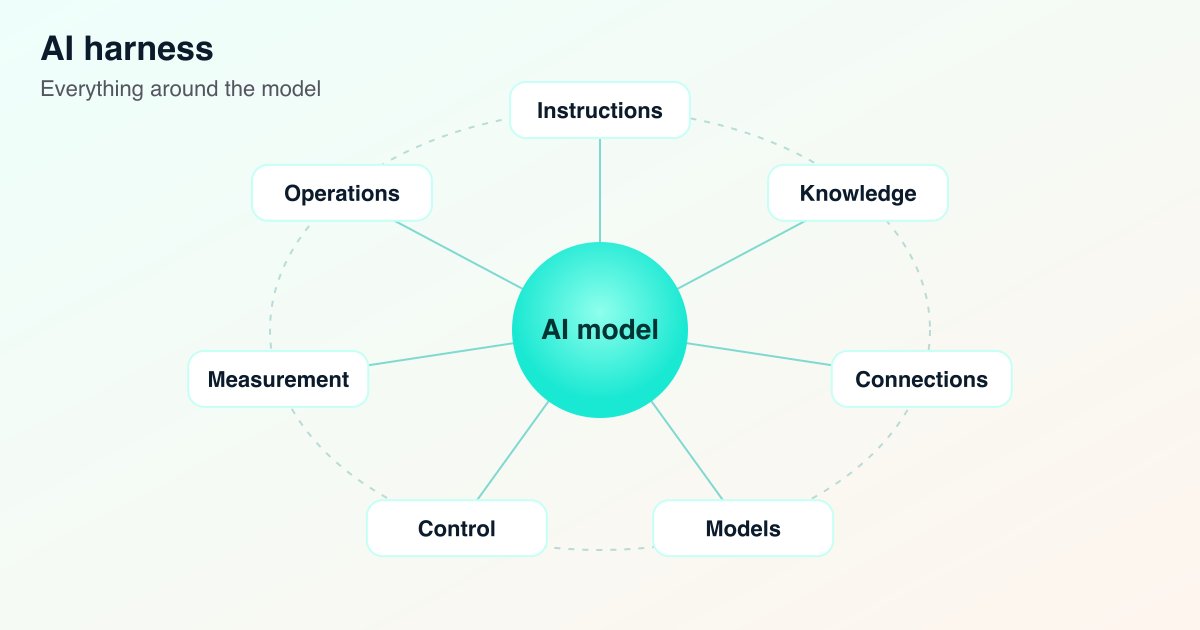
An AI harness is everything built around an AI model so it works reliably: instructions, knowledge, tools, execution and control. Practitioners sum it up in a short formula: agent = model + harness. The model brings the language ability. The harness turns it into work that lands in your processes.
LangChain defines the harness as all the code and configuration outside the model (LangChain, March 2026). The term comes from the developer world and only spread in 2026.
Where the term comes from
A harness is what lets a draught horse pull a cart. The trade publication diginomica uses exactly this picture: the animal’s strength only becomes useful through the harness (diginomica, June 2026).
For manufacturers and service companies, a picture from the shop floor fits better: the model is the engine, the harness is the machine around it, with controls, safety guards and a counter. An engine on its own does not produce a single part.
Why a model alone gets no work done
Many companies have tried ChatGPT or Copilot. Individual employees write faster with it. The process itself often stays the same: enquiries, quotes and complaints run as before. The model is rarely the reason. It lacks the environment:
- It does not know your company. Price lists, past quotes, guidelines and product data live in your systems.
- It cannot reach your systems. Mailbox, Excel lists, database and file storage stay out of reach.
- It does not know your rules. Who may grant which discount? Above which amount does a person decide?
- Nobody checks the result. Without a log and an approval step, it stays unclear what the AI did and why.
The harness closes exactly these gaps.
The seven building blocks of an AI harness
diginomica names four building blocks: instructions, memory, execution and connections. For mid-sized businesses, three more questions come from management, IT and data protection: who do we depend on, does it pay off, and where does our data run? That makes seven building blocks.
| Building block | The question behind it | Example |
|---|---|---|
| Instructions | How do I tell the AI what to do? | A fixed process for incoming complaints, described in your own words |
| Knowledge | How does the AI know our company? | Past quotes, manuals and a database as knowledge sources |
| Connections | How does it reach our systems? | Incoming email, Excel and Word files, webhook, database query |
| Models | Who do we depend on? | Choose the model per step and switch it at any time |
| Control | Who may do what, and who checks the result? | Approval above an amount, roles, audit log, pseudonymization |
| Measurement | Does it pay off? | Runs, duration and consumption per process |
| Operations | Where does our data run? | A data centre in Germany or your own servers |
Why choosing the harness matters more than choosing the model
AI models get better and cheaper in short cycles. The model you pick today may be replaced in a year. The harness, on the other hand, carries what makes your company yours: your knowledge, your processes and your rules. diginomica therefore concludes that in the enterprise, the choice of harness matters more than the choice of model.
That leads to a practical rule: build your knowledge and processes so the model stays replaceable. Then every better model benefits you without starting over.
What to look for when you choose one
- Model choice: Can you pick and switch the model per step, including local models?
- Knowledge without training: Does the AI access your company knowledge without models being trained on it?
- Readability: Can your department understand what a process does without reading code?
- Control: Are there approvals, roles and a log of who changed what and when?
- Measurement: Can you see how often a process runs, how long it takes and what it consumes?
- Operations: Does your data run in Germany or on your own servers?
- Costs: Do you pay model costs directly to the provider, or is there a mark-up?
The schnell.digital AI Kit as a harness
The schnell.digital AI Kit is the AI platform for mid-sized businesses that turns any AI model into reliable work in your processes. It covers all seven building blocks: you describe processes in your own words, connect knowledge and systems, choose the model per step and stay in control with approvals, roles and an audit log. It runs in Germany or on your own servers.
The features by building block show the details. What is new in autumn 2026 is described in the autumn 2026 release.
Sources
- LangChain: The Anatomy of an Agent Harness, Vivek Trivedy, 10 March 2026
- diginomica: In enterprise AI, the agent harness you choose matters more than the model, Ian Thomas, 25 June 2026